Wolf service · 32207
Wolf Ranges in 1920s San Marco Kitchens
A 1920s floor plan, an exterior nobody can cut into casually, and a low riverfront street — three constraints stacked on one appliance.
- ZIP codes
- 32207
- What shapes the work here
- Pre-war kitchens, retrofitted openings
- Communities
- San Marco · Epping Forest
The housing stock around San Marco Square dates largely from the 1920s, which means kitchens laid out for an icebox and a stove around 40 inches wide. Almost every one of them has been opened up since — many of them twice — and the renovations were built inside framing nobody wanted to move. That is the constraint behind most of what we are called out for in 32207, and it is a constraint that follows the appliance for its entire service life rather than showing up as a single fault on a single day.
The 1920s kitchen problem
The retrofit issues here are specific and repeatable.
Openings that are close but not right. Cabinet openings are frequently an inch or two narrower than a 48-inch range needs once you account for the clearances the appliance actually requires, so ranges get shoehorned in with no side air gap. An appliance with nowhere to shed heat sideways runs warmer than its designers assumed, and the parts that mind are the ones above the cavity — the control board first, then hinge springs and igniters. When we open one of these up and find electronics cooked at fifteen years instead of twenty-five, the install is usually the explanation.
Gas runs sized for something smaller. The meter has often been upgraded; the pipe from the meter to the back of the house frequently has not. A long, undersized run holds normal pressure at rest and drops it under full load. The symptom is a burner that behaves perfectly on its own and misbehaves when the oven and three other burners are working, which reads exactly like a component fault. It is not one, and replacing components does not fix it.
No dedicated 20-amp circuit. Even an all-gas range needs power for ignition and controls, and in these houses that power usually comes off a shared kitchen circuit carrying a refrigerator and a countertop full of small appliances. Control electronics on a loaded shared line produce intermittent faults that imitate a dying board exactly.
What we check before we quote a board
That last point sets the testing order in this ZIP. Supply first: the breaker, both legs of a 240-volt circuit, the receptacle behind the appliance, and whether the range is sharing a line with half the kitchen. Five minutes, no parts, and it has talked more than one San Marco owner out of a board they did not need.
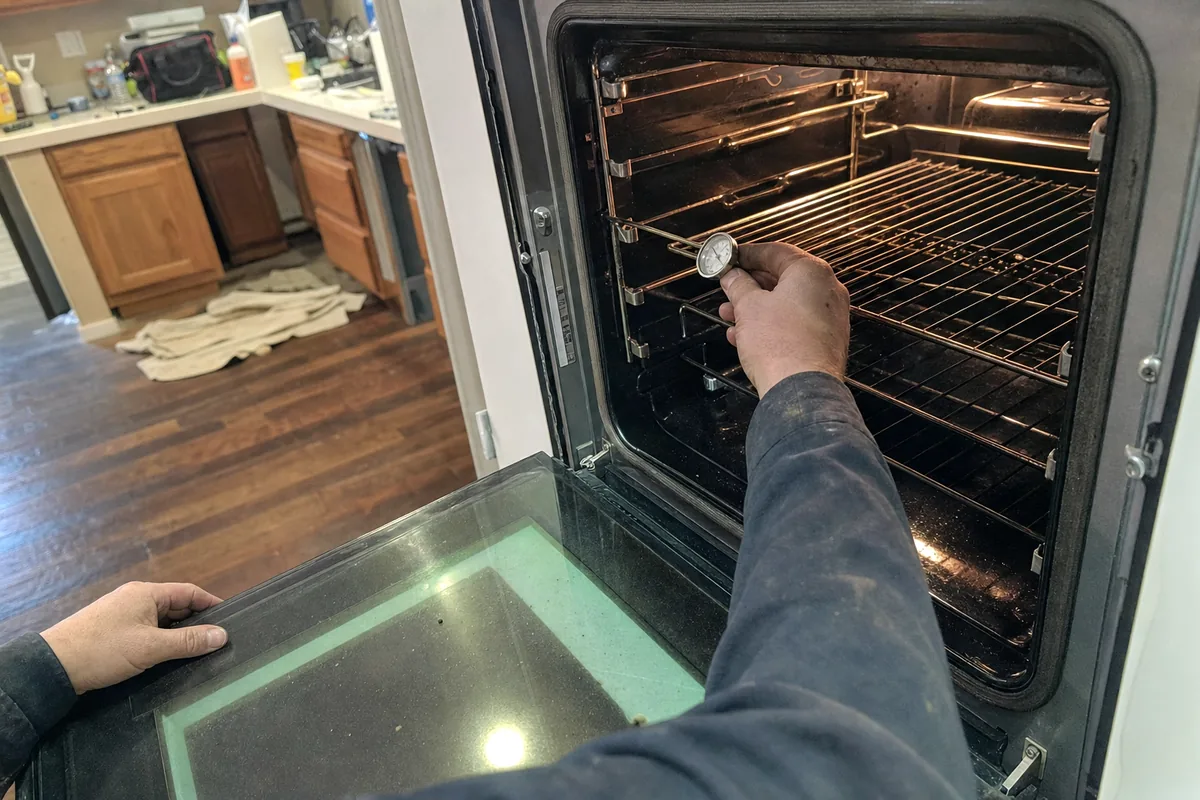
Then the measurable components — probe resistance against the specified curve, element and igniter continuity, door switch and latch operation, hinge behaviour under load. These are cheap, quick and account for most of what gets blamed on electronics.
The board is last, because it is the most expensive part in the appliance and the slowest to arrive. Parts here are ordered against the model and serial from the data plate, and on an older unit the serial genuinely matters: production details change mid-run, so two appliances wearing the same model number do not always take the same board or the same burner assembly.
Ventilation through a 1920s wall
Hood ducting is the other San Marco constant. Running a proper duct from a kitchen at the back of a 1920s house to an exterior wall usually means going through plaster, through original framing and sometimes through masonry — and San Marco sits inside an area where exterior changes to older properties can fall under the city’s historic preservation review. Ducts therefore get routed long, with more elbows than anyone would choose, and the hood underperforms from the day it is installed.
When we are called here for weak extraction, the first question is whether it ever worked properly, not what broke. If it did and no longer does, it is filters or a damper stuck at the wall cap nine times in ten. If it never did, no blower we can fit will change the duct it has to push through, and we will tell you that rather than sell you one.
The river
San Marco sits low along the St. Johns, and the neighbourhood knows what that means. For appliances the relevant consequence is humidity and standing damp under cabinetry. Spark modules and igniter bases are the parts that care: moisture bridging across a ceramic igniter base makes a cooktop click continuously long after the burner is lit, and it clears on its own once the surface is genuinely dry. Before assuming a module has failed here, give it a dry day.
The same damp is why we look at the underside of a built-in when it comes out on its rails. Corroded terminals and a green bloom on a connector shell explain more intermittent faults in low-lying kitchens than any component failure does.
Repair or replace
Built-in equipment is worth repairing far longer than freestanding equipment, because replacing it is rarely just an appliance purchase in a house like this — the opening, the gas run and the circuit all come back into question. That maths usually favours the repair. It does not always, and on a very old unit needing a board plus a sensor plus labour we will say so at the diagnostic rather than at the end of the job.
Working here
We work San Marco and the stretch of riverfront toward Epping Forest regularly. The flat $80 diagnostic covers the trip and the testing and comes off the repair, and you get a written estimate with the part number on it before anything is ordered. Parts are genuine OEM.
$80 flat diagnostic, credited toward the repair when you go ahead with it. +1 (904) 867-2707
What it costs
What does a Wolf repair cost in San Marco?
The visit itself is a flat $80. That buys the trip and the whole diagnostic sequence, and it comes off the total the moment you approve the work. What the work runs to on equipment of this class is below.
| What gets replaced | Parts and labour |
|---|---|
| Igniter or spark module replacement | $200–$510 |
| Burner valve or orifice service | $210–$690 |
| Oven thermostat or temperature sensor | $190–$530 |
| Convection fan or motor | $250–$680 |
Questions
Asked in San Marco
- Why does a cooktop here click long after the burner is lit?
- San Marco sits low along the St. Johns, and the parts that mind the damp are the spark module and the igniter bases. Moisture bridging a ceramic base keeps the module firing after the flame is proved, and it clears on its own once the surface is genuinely dry. Give it a dry day before assuming the module has failed.
- Is a 1920s opening really the reason the control board failed?
- It is a large part of it. Cabinet openings here are often an inch or two narrower than a modern range needs once its clearances are allowed for, so the appliance is shoehorned in with no side air gap. With nowhere to shed heat sideways it runs warmer than its designers assumed, and the board above the cavity is the first thing that minds.
- When does the repair-or-replace answer go the other way here?
- On a very old unit needing a board plus a sensor plus the labour to fit both. Built-in equipment is worth repairing far longer than freestanding equipment, because replacing it puts the opening, the gas run and the circuit back in question. When the maths stops favouring the repair we say so at the diagnostic, not at the end of the job.
Owner reports
What owners in San Marco said afterwards
4.3 out of 5 from 81 published reports. Each one is a single visit, in the words of the person who paid for it.
The whole top would light but the oven would not, and the panel gave nothing away. He isolated a broken wire in the harness where it passes the hot side of the cavity and repaired it with proper high temperature sleeving.
Barrett S.
The light bar inside the hood kept flickering on and off. He replaced the driver and it behaved for a while, but the flicker came back and needed a second call before the fault was properly gone.
Gideon F.
Everything I baked came out dark underneath. He put a probe in the cavity, showed me it was running well above the set point, and replaced the temperature sensor. Bread comes out the colour it should now.
Harlan W.