Asked often
Questions people actually ask
Everything we get asked twice a week, grouped by what it is about. If the one you want is not here, the phone is the fastest route to an answer about a specific Wolf appliance.
The shop
Who turns up, what they hold, and who they are not sent by.
- Are you sent by the manufacturer?
- No. Nobody at the factory sent us, appointed us or vets us, and we hold no manufacturer programme of any kind. We name the brand because it is the only brand we work on, and because you need to know your appliance is the kind we carry parts and test equipment for. The formal statement of our standing is in the footer of every page.
- Do you work on other brands?
- No. One manufacturer, one set of service manuals, one parts shelf. A technician who works on everything owns a little knowledge about a lot of machines. We would rather know one line of cooking appliances properly, including the older units that have been in a kitchen for fifteen years.
- Do you do heating or air conditioning work?
- No. This is a kitchen shop. We service built-in Wolf cooking appliances — ranges, rangetops, cooktops, wall ovens, steam ovens, warming drawers and the hood above them. Furnaces, air handlers, heat pumps and the duct systems that serve them are a different trade with a different licence, and sending us would only cost you an afternoon. The one duct we work on is the one a kitchen hood exhausts through.
- When can you come out?
- Monday to Friday, 8am to 6pm, and Saturday 9am to 4pm. We are closed Sunday and we do not run an after-hours or emergency line. Booking a real window and turning up inside it beats promising a midnight call-out we would not want to make.
- What certifications do your technicians hold?
- EPA Section 608 certification, which is the federal credential required to handle refrigerant on sealed systems. It is held by the technician, not granted by any appliance manufacturer. We are also licensed and insured in the State of Florida.
- What should I do before the technician arrives?
- Clear the front of the appliance and make sure we can get to the shut-off — the gas valve behind or below the range, the breaker for the oven circuit. If the unit is built in, note whether it has ever been pulled out before. And write down when the fault started and what happened first: a storm, an outage, a self-clean cycle. That sequence is often half the diagnosis.
Money
What the visit costs, what the estimate covers, what happens after.
- What does the first visit cost?
- A flat $80 diagnostic. That covers the trip, the testing and a written explanation of what is wrong. If you go ahead with the repair, the $80 comes off the total. You get the written estimate before any part is ordered and before any labour is billed, so nothing is a surprise.
- Do you charge by the hour?
- No. The visit is one flat diagnostic fee, and the repair itself is quoted as a band for the job with parts and labour together. Nothing runs on a clock, so a fault that takes three careful tests to find costs you the same as one that announces itself in the first minute.
- What is covered after the repair?
- 90 days on the labour and 365 days on the parts. We fit genuine OEM parts, which is why the parts warranty runs a full year. If the same fault comes back inside those windows, the return visit is ours.
- Do you use the fifty per cent rule?
- Only as a starting point. That rule was written for appliances you can swap in an afternoon, and a built-in is joined to the kitchen, so the replacement side of the sum carries delivery, the install and often cabinetry as well. We set the repair band against the real replacement figure instead, and the repair-or-replace page does that arithmetic in public.
The appliance
Model plates, parts, and the question of whether to fix it at all.
- Where is the model and serial number?
- On a range, look behind the kick panel at the bottom, or on the frame inside the left-hand door jamb where the door closes against it. On a wall oven it is usually on the side of the opening once the door is open. Photograph the whole plate rather than copying it out; a single transposed character is the difference between the part that fits and the part that does not.
- My oven is not heating. What is usually wrong?
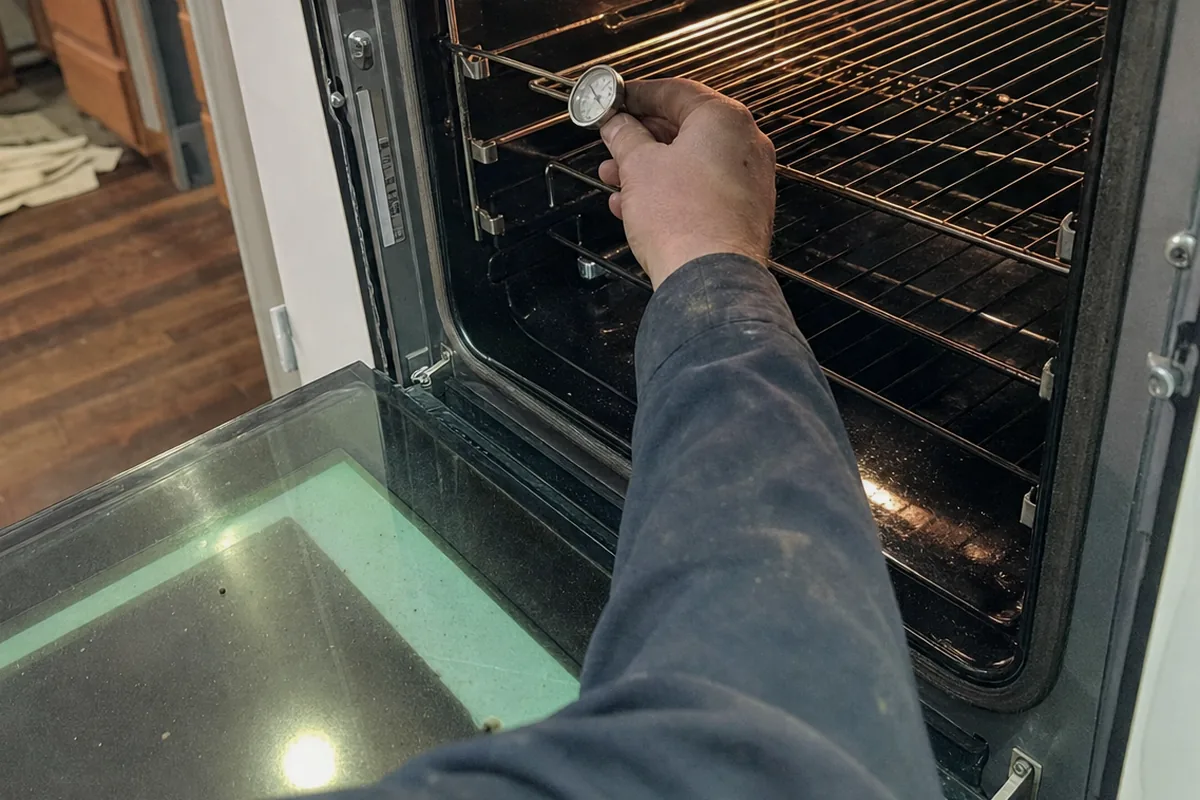
- Usually the temperature probe rather than the element. A sensor that has drifted high makes the board believe the cavity is hotter than it is, so it stops calling for heat early or never calls for it at all. A dark display over burners that still light is a supply problem instead, and that is checked before anything is quoted.
- Do you carry parts on the van?
- The ones that fail often: igniters, spark modules, oven sensors, door hinges, gaskets and a short list of switches. A control board or a specific burner assembly is ordered against your model and serial, which takes a few days. Because we only work on one manufacturer, the shelf is deep in one direction rather than shallow in twenty.
- Which part is the expensive one to replace?
- The electronics. A control board or touch panel is the dearest line on our table, ahead of anything mechanical on these appliances, and it is also the part most often taken out by a supply event rather than by wear. That is why we test the supply before quoting one, not after it has been fitted.
- Will you tell me if it is not worth fixing?
- Yes, and we would rather say it at the diagnostic than after you have paid for a part. On a twenty-year-old built-in, a board plus a sensor plus labour can land close enough to a replacement that the honest answer is to say so. You paid for the diagnosis; the diagnosis includes that conversation.
This county
How far we go, and why the tap water changes the diagnosis.
- How far do you travel?
- Duval County and about 40 miles out from downtown Jacksonville, which reaches the St. Johns and Clay County lines. If you are close to the edge of that, call and ask rather than guessing.
- My oven has been odd since the last big storm — is that connected?
- Often, yes, and not always the same day. Jacksonville averages around 68 thunderstorm days a year, and what damages appliance electronics is usually not one clean outage but a supply that drops out and comes back several times in a minute. An appliance can come through that night looking fine and develop an intermittent fault weeks later. Before we quote a board we check the supply, because one lost leg of a 240-volt circuit gives you a dark display with burners that still light and costs nothing to put right. Tell us when the trouble started and what happened first; that sequence changes the order we test in.
What it costs
How much is a Wolf repair before anybody opens the appliance?
The visit itself is a flat $80. That buys the trip and the whole diagnostic sequence, and it comes off the total the moment you approve the work. What the work runs to on equipment of this class is below.
| What gets replaced | Parts and labour |
|---|---|
| Igniter or spark module replacement | $200–$510 |
| Burner valve or orifice service | $210–$690 |
| Oven thermostat or temperature sensor | $190–$530 |
| Convection fan or motor | $250–$680 |
Nothing here matching what your appliance is doing? Describe it on the phone — the sequence usually narrows it faster than a search does. +1 (904) 867-2707 Asking whether it is worth fixing at all? The arithmetic, with both tables.