symptom · October 10, 2026
Wolf Electric Cooktop Problems by Symptom
Dead panels, zones that cut out, CI induction codes and the glass itself, with the owner checks worth trying before you book a visit..
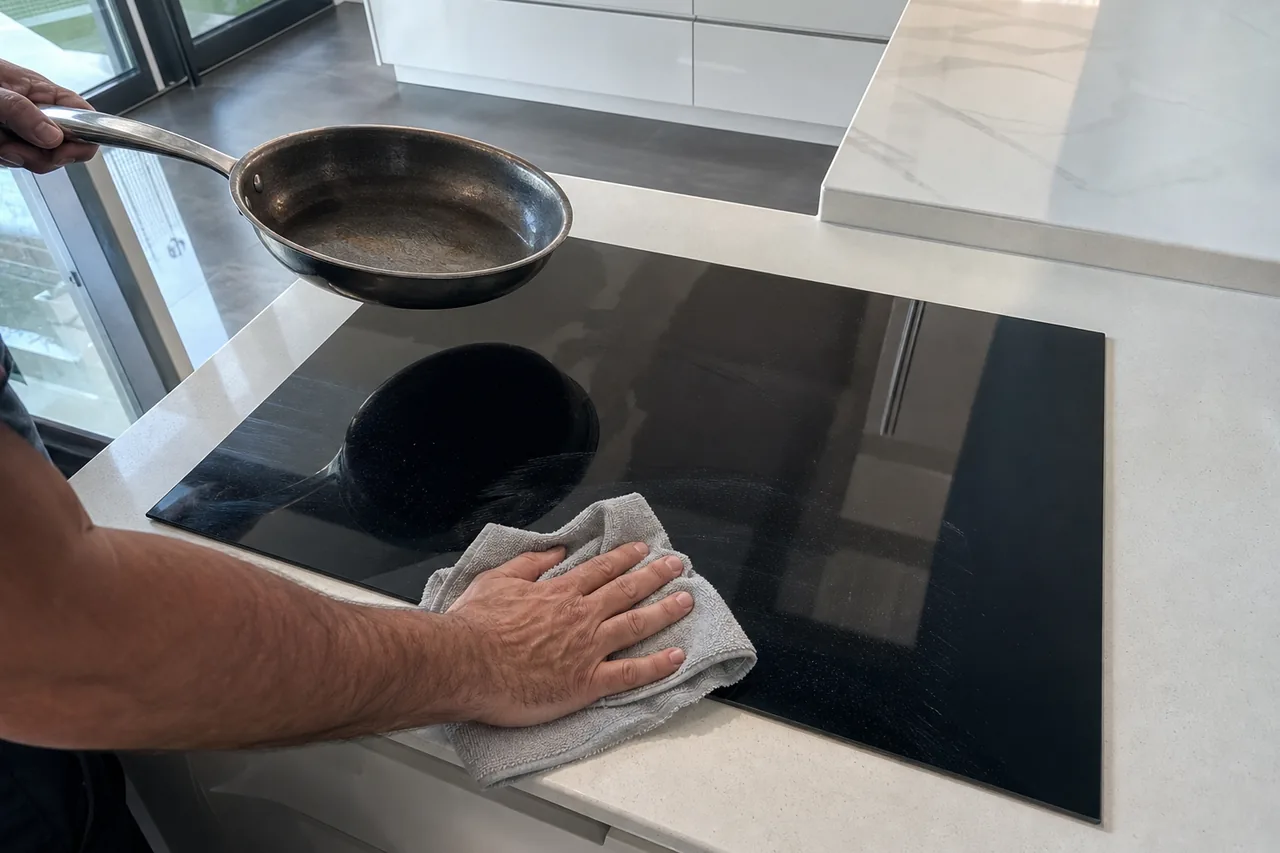
Most Wolf electric cooktop problems trace back to one of four things: the circuit feeding it, the control lock, a built-in safety timer, or an electronic fault the display reports as a code. The most useful owner step is to switch the cooktop’s breaker off for 30 seconds and back on, which clears a fair share of glitches on both radiant and CI induction models. If the fault returns after that reset, the symptom it shows tells you whether you are looking at a setting, a pan or a part.
This note covers smooth-glass radiant and induction tops. If your cooktop burns gas and you can smell it, skip every step here: turn the knobs off, leave the house and call the gas utility from outside.
Nothing lights up, or the panel ignores you
A cooktop runs on a 240-volt circuit through a double breaker, and when only one half trips the display can glow normally while the elements stay cold. Switch that breaker fully off, wait 30 seconds, and switch it back on rather than just pressing it.
If the cooktop has power but every touch is ignored, look for the lock symbol. Wolf panels lock themselves after 10 minutes without a touch, which looks like a dead control. Wipe the panel dry while you are there: water, a damp towel or a pot lid resting on the controls can register as touches, and on the IR induction range a spill that reaches the control strip deliberately shuts the cooktop down with a chime.
In Jacksonville, a cooktop that went dark during a summer thunderstorm deserves a breaker reset before anything else, though a surge can also take out a board outright, as the Mandarin district note explains.
A zone that switches itself off
Before suspecting a fault, check the clock. Wolf radiant and induction cooktops turn a zone off automatically after 2 hours of continuous use on high, 6 hours on a medium setting and 8 hours on simmer, unless Sabbath mode is running. A stock left bubbling all afternoon will reach that limit.
On induction, the pan is the next suspect. Hold a kitchen magnet to its base: if it doesn’t grip firmly, the zone cannot detect the pan and will flash or drop out. A pan much smaller than the ring, or one with a warped base that rocks, can do the same.
Induction electronics are cooled by a small fan under the glass, so a zone that throttles back or quits during long, hard use can mean the cooktop is protecting itself from heat. Check that nothing is packed against the underside, such as a drawer of baking sheets pushed up tight. Our induction cooktop repair page goes further into the zone that keeps cutting out.
What the codes on a CI induction cooktop mean
Note the code before resetting anything.
- E8 is a fan fault. Turn the breaker off for 10 seconds, then on again. If E8 comes back, book a service visit.
- E4 means the controls judge their own configuration implausible, which points at the control board. Cut the breaker for 30 seconds before calling.
- E9 gets the same 30-second breaker reset and a retest; if it persists, the cooktop needs a technician.
- E01 on an IR induction range flags a key fault on the left secondary control. Again, leave the breaker off for 30 seconds, then try it.
Describe any other code in words: what it says and when it appears.
Signals that are normal
Several things that look like faults are there by design. The hot-surface light can stay on after the cooktop is off; it is warning about leftover heat in the glass and goes out as the surface cools. On a radiant element, the coil glowing and dimming at lower settings is simply how it holds a temperature. Induction pans can hum or tick at high power, and the cooling fan may keep running for a while after you finish.
If a griddle, open roaster or fish poacher heats unevenly across two zones, turn on the bridge element; Wolf says those pans should not be used without it. And if the beeps are too loud or the automatic lock gets in your way, the extended options let you change them: with the cooktop off and unlocked, touch and hold All Off for five seconds.
Looking after the glass
Let the glass cool, then clean it with a non-abrasive cream made for glass-ceramic tops. Anything that melts onto the surface, such as sugar, plastic or foil, should be lifted with the razor scraper that came with the cooktop while the glass is still hot, wearing an oven mitt, because sugar left to set can pit the surface. A cracked or chipped top is not a cleaning problem: switch the breaker off and leave it off until the glass is replaced, since spills can reach live parts beneath.
When to stop and call
Stop using the cooktop and call if you see scorching or smell burning from under the glass, if the breaker trips again the moment you reset it, if a zone stays hot after being switched off, or if a code returns after its reset. A visit starts with an $80 diagnostic. If the fault turns out to be the control board or touch panel, the typical range is $460–$1,070, with the firm figure given once the problem is confirmed.
$80 flat diagnostic, credited toward the repair when you go ahead with it. +1 (904) 867-2707
What it costs
What does this fault cost to put right?
The visit itself is a flat $80. That buys the trip and the whole diagnostic sequence, and it comes off the total the moment you approve the work. What the work runs to on equipment of this class is below.
| What gets replaced | Parts and labour |
|---|---|
| Igniter or spark module replacement | $200–$510 |
| Burner valve or orifice service | $210–$690 |
| Oven thermostat or temperature sensor | $190–$530 |
| Convection fan or motor | $250–$680 |
Questions
Asked about this note
- Why did my Wolf cooktop turn off by itself in the middle of cooking?
- Usually because a safety limit did its job. A zone left running shuts off after 2 hours on high, 6 on medium or 8 on simmer outside Sabbath mode. On induction, a pan the zone stops detecting, overheated electronics or liquid on the controls can also end a session. If none of those fit and it keeps happening, have it checked.
- How do I reset a Wolf induction cooktop?
- Use the breaker, not the touch panel. Switch the cooktop's breaker off, wait 30 seconds, switch it back on and retest; for an E8 fan code the official wait is 10 seconds. A reset clears a passing glitch, but a code that keeps returning means a part needs attention.
- Why is the hot light still on when the cooktop is off?
- That light reports heat in the glass, not whether a zone is switched on, so it can stay lit for a while after cooking. It should fade as the surface cools. If the glass itself stays hot long after everything is off, cut the breaker and call for service.
- What does a Wolf cooktop repair cost?
- A visit starts with the $80 diagnostic. Control board or touch panel work typically falls in the $460–$1,070 range, with the firm price set after the fault has been diagnosed rather than guessed at over the phone.