parts · August 15, 2026
When a Built-In Is Worth Repairing
Why the repair-or-replace maths on built-in cooking equipment is different from anything freestanding, and what we weigh before answering it.
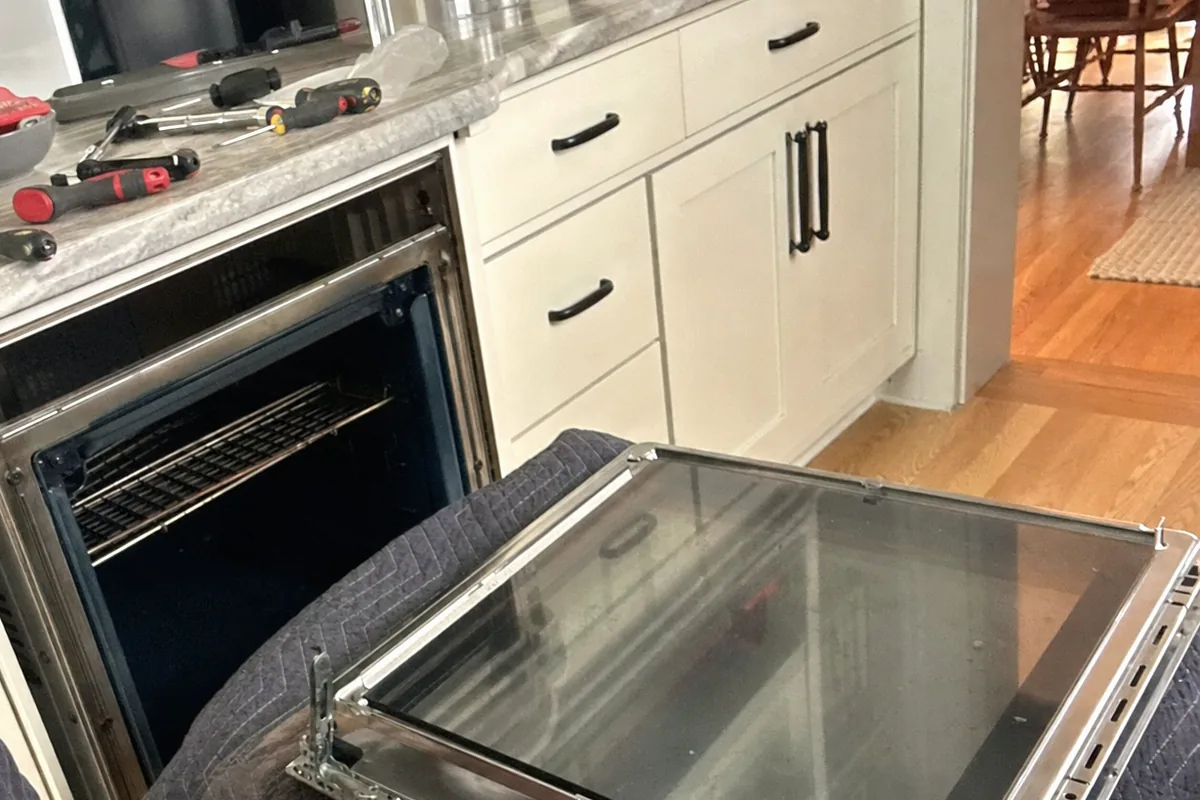
Every diagnostic on an older appliance ends with the same question, and it is usually asked in the same slightly apologetic way: is this thing worth fixing?
It is a fair question and it deserves a real answer rather than a sales one. The answer for built-in cooking equipment is different from the answer for anything freestanding, and the reason has very little to do with the appliance itself.
Replacing a built-in is not an appliance purchase
A freestanding range can be swapped in an afternoon. Anything can go into the space that the old one came out of, near enough, and the worst case is a slightly different gap at the sides.
A built-in is joined to the kitchen. Pull one out and the opening, the gas run, the electrical circuit, the ducting and the surrounding cabinetry all come back into question at once. The replacement has to fit an opening that was built around a specific unit, which in an older Jacksonville kitchen was frequently already an inch tighter than it should have been. Trim that matched the old unit will not match the new one. A wall oven that was flush may no longer be.
So the honest comparison is never the repair quote against the sticker price of a new appliance. It is the repair quote against the sticker price plus delivery, plus installation, plus whatever the opening needs to accept the new unit, plus the cabinetry work if the new unit’s dimensions differ from the old one’s by even a small amount. That total is what shifts the maths toward repair far more often than people expect.
What is cheap to fix and what is not
Broadly, the parts that fail most often are the affordable ones.
Igniters, spark modules, oven temperature sensors, door switches, hinges and gaskets are the everyday work. They are the parts that ride on the van, they are quick to fit, and a repair built out of them on a fifteen-year-old appliance is almost always good money.
Control boards, generator assemblies on a steam oven, blower motors and complete burner or manifold assemblies are the expensive end. One of those on its own is often still worth doing. Two of them stacked on the same visit, plus labour, is the point where the conversation changes — and that is a conversation we would rather have at the diagnostic than after a part has been ordered against your name.
Parts availability is the real constraint
An appliance stops being economically repairable when the parts stop existing, not when it hits a particular birthday.
Everything is ordered against the model and serial from the data plate, and on older equipment the serial genuinely matters. Production details change during a model’s run, so two appliances wearing the same model number do not always take the same board, the same igniter or the same seal. That is why we photograph the plate rather than copying it out, and why a transposed character is the difference between the part that fits and the part that goes back.
Two things then decide the answer. Lead time: common parts are days, less common ones can be weeks, and you should know which one you are agreeing to before the oven is out of the wall. And supersession: manufacturers replace discontinued components with newer equivalents, and the newer part occasionally carries a different footprint or connector that has knock-on consequences for the install. Neither of these is a reason to walk away. Both are reasons to have the part number in writing before anything is committed.
What we look at besides the fault
The fault in front of us is only part of the assessment. Before we advise either way, we look at the condition of the rest of the machine.
Is the cavity sound, or is the porcelain breaking down? Do the door seals still compress? Are the hinges holding the door square? Is there corrosion on connectors and terminals underneath, which in a low-lying or damp kitchen tells us more about the appliance’s future than its age does? Has it been installed with the clearance it was designed around, or has it been running warm in a tight opening since day one — because if it has, the board we replace today is sitting in the same conditions that finished the last one.
An appliance that is mechanically sound with one failed component is worth fixing. An appliance that is being held together at four points at once is telling you something, and we will pass that on.
When to call the manufacturer instead
There are cases where the right advice is not to hire us at all.
If the unit is still inside the manufacturer’s warranty, use it — an independent repair may cost you that cover. If there is an open safety campaign or recall on the model, that work is handled through the manufacturer’s own channel and should be. And if a repair depends on a component or a service procedure the manufacturer releases only through its own service network, we will tell you plainly rather than improvising around it. We are independent, and being independent means the scope limits are real ones.
How to make the decision easy on yourself
Get the diagnostic done first. Get the estimate in writing with the part number on it. Ask what the part costs, what the labour costs and how long the part takes to arrive — all three, before you decide anything.
Then compare that number against the true replacement cost of a built-in in your kitchen, not against a showroom price. In most of the houses we work in, that comparison answers itself.
This note is the reasoning. The arithmetic that goes with it — our repair bands set beside what replacing a built-in actually costs, and the point where the two meet — is laid out on the repair-or-replace page.
$80 flat diagnostic, credited toward the repair when you go ahead with it. +1 (904) 867-2707
What it costs
What does the part in this note cost to fit?
The visit itself is a flat $80. That buys the trip and the whole diagnostic sequence, and it comes off the total the moment you approve the work. What the work runs to on equipment of this class is below.
| What gets replaced | Parts and labour |
|---|---|
| Convection fan or motor | $250–$680 |
| Oven thermostat or temperature sensor | $190–$530 |
Questions
Asked about this note
- Why is the repair-or-replace answer different for a built-in?
- Because replacing one is a cabinetry project rather than an appliance purchase. The opening, the gas run, the circuit and often the ventilation all come back into question, and the appliance itself is only part of the bill. That is why built-in cooking equipment stays worth repairing years past the point a freestanding unit would not.
- What decides the answer besides the price of the part?
- Parts availability, mostly. A fault with a part still in production is a repair; the same fault on an appliance whose board has gone obsolete is a different conversation, and we would rather have it at the diagnostic than after a week of waiting. The condition of everything we can see while the unit is out counts too.