maintenance · October 26, 2026
Wolf Broil Settings: Levels, Racks and Timing
Broil levels, rack heights, door and pan choices, plus the settings that make a healthy Wolf broiler look broken..
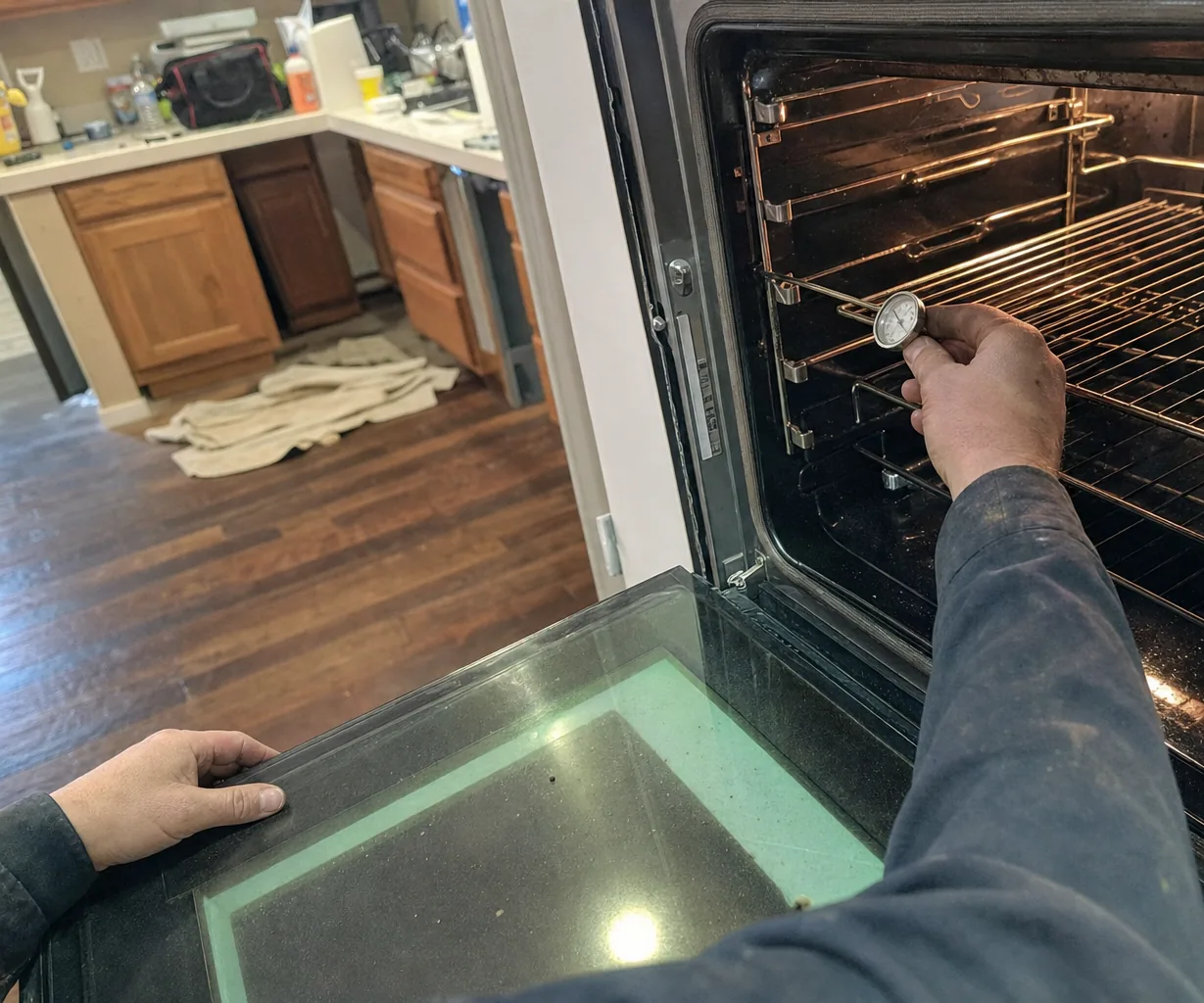
Wolf broil settings come down to three choices: how hard the broiler works, how close the food sits to it, and whether the convection fan joins in. On an electric Wolf oven, high broil with the rack near the top suits thin steaks, chops, burgers and fish fillets, while a medium or low level with the rack a step or two lower suits bone-in chicken and anything thick that has to cook through before the outside burns. Keep the door closed the whole time, and let the broiler reach full heat for a few minutes before the food goes in.
Some ordinary settings can make a healthy broiler look broken, so those come before the real faults.
What the broil levels actually change
A lower broil level does not use a cooler element. On an electric Wolf oven, including the oven of a dual fuel range such as the DF3050, DF3650, DF4850 or DF6050, the element runs at full output whenever it is switched on. Medium and low just leave it off for longer pauses, so the element glows, goes dark and glows again, which is easy to mistake for a failing part.
Whether a level marked 1 or 3 is the stronger one depends on how your panel names them, so read the display or the use and care guide before guessing. Where the choices read high, medium and low, high is full power and is what most recipes mean when they just say broil.
On an all-gas Wolf range, broil lights a burner across the top of the cavity; if it clicks but never catches, see the gas range repair page.
Rack height, door and pan
Keep the door shut. Current Wolf ovens are built to broil closed, and an open door spills the heat over the knobs and controls instead of the food.
Distance matters as much as the level. Thin food wants roughly 3 to 4 inches between its surface and the element, which usually means the top rack position. Thicker cuts and poultry do better about 6 to 8 inches down, where the outside browns at a pace the inside can match.
Use a slotted broiler pan or heavy metal tray, never glass bakeware, which can crack under direct heat. Skip parchment, and never foil over the grid slots, because trapped fat starts flare-ups. Switch the hood on before you begin.
Starting points for everyday foods
- Steaks and chops about an inch thick: high, top rack, turned once halfway.
- Burgers: high, top rack, turned once.
- Fish fillets: high for thin pieces, medium for thick ones; thin fillets rarely need turning.
- Bone-in chicken: low or medium, rack two or three positions down, cooked to 165°F in the thickest piece.
- Gratins, melted cheese and toasted bread crumbs: high, top rack, and stay at the oven window, since the last stage takes moments.
When convection broil earns its place
With the fan running, hot air moves around the sides and underside of the food, so a thick steak or a tray of chicken quarters cooks more evenly and needs less flipping. For thin food, or when only the top should brown, plain broil is the better pick because the moving air can dry the surface before it colors.
Convection in general shines for roasting, crisping vegetables and baking on several racks at once; Convection Roast suits a large roast or whole bird, while cakes and custards do better on plain bake.
Settings that make a working broiler look dead
Lock. On ovens that have a Lock key, a three-second press and hold locks or unlocks the panel and touchscreen, and the lock needs resetting after a power outage. After a summer thunderstorm knocks the power out across Jacksonville, check this before anything else; the Mandarin district note explains when a storm does real damage to a board.
Sabbath. On some Wolf ovens, Sabbath limits you to Bake, Roast, Proof and Warm, so broil simply cannot be chosen. The oven slips into Sabbath ten seconds after you press Start, and any new temperature you set takes effect at a random moment.
Timers. Timer 1 and Timer 2 count down on their own and never touch the oven’s cook time or stop time. Depending on the model a timer can run as long as 11 hours and 59 minutes or as long as 99 hours and 59 minutes, but when it beeps the broiler keeps going until you switch the mode off.
The 12-hour limit. Some Wolf ovens switch themselves off after 12 hours of nonstop use, except in dehydrate or Sabbath, which can look like a dead oven.
First-use smoke. A new oven smokes the first time it broils. For a Wolf gas range the break-in routine is Bake at 500°F (260°C) for 30 minutes, then Broil for another 30 with the hood running, then cooling with the door closed. Grease baked onto the oven floor smokes too, which the oven maintenance routine deals with.
Temp Offset and Calibration. In the settings menu, Temp Offset is meant for service use only, and the Calibration option there adjusts how the touchscreen responds, not how hot the oven runs. An offset shifts every cooking mode at once, so if someone changed it before, tell the technician.
When the broiler needs a technician
Book a visit if the element shows a blister, a crack or a section that stays dark on high, if a gas broil burner will not light, or if the oven bakes normally but barely broils. An oven that runs wrong in every mode points toward the temperature sensor or the control rather than the broiler itself. If you ever smell gas, turn the oven off, leave the house and call the gas utility from outside.
A visit starts with the $80 diagnostic. Thermostat or temperature sensor repairs typically run $190–$530, and control board or touch panel work $460–$1,070, with the firm figure given once the fault is diagnosed. Wall oven faults have their own wall oven repair page.
$80 flat diagnostic, credited toward the repair when you go ahead with it. +1 (904) 867-2707
What it costs
What does this kind of maintenance cost?
The visit itself is a flat $80. That buys the trip and the whole diagnostic sequence, and it comes off the total the moment you approve the work. What the work runs to on equipment of this class is below.
| What gets replaced | Parts and labour |
|---|---|
| Convection fan or motor | $250–$680 |
| Oven thermostat or temperature sensor | $190–$530 |
| Burner valve or orifice service | $210–$690 |
Questions
Asked about this note
- Is broil 1 or broil 3 hotter on a Wolf oven?
- That depends on how your control labels its levels, so confirm it on the display or in the use and care guide instead of assuming. The mechanics are the same either way: the element reaches full heat whenever it is on, and the gentler levels simply leave it off for longer between bursts. If every level feels equally weak, the element or its control deserves a check.
- What broil setting should I use for chicken on a Wolf oven?
- Use low or medium with the rack two or three positions below the top, so the meat cooks through before the skin scorches. Start bone-in pieces skin side down, turn them once, and stop when the thickest piece reads 165°F on a meat thermometer. A minute on high at the very end crisps pale skin.
- When should I use convection broil instead of regular broil?
- Pick convection broil for thick food, such as a steak over an inch and a half or chicken quarters, because the fan pushes heat around the sides and cuts down on turning. Plain broil is better for thin fillets, burgers and anything where you only want the top browned, such as a gratin or melted cheese.
- What does a Wolf broiler repair cost in Jacksonville?
- Every visit starts with the $80 diagnostic. A thermostat or temperature sensor job typically falls between $190–$530, ignition work on a gas broil burner between $200–$510, and control board or touch panel work between $460–$1,070. Those are typical ranges; the firm price comes after the fault has been diagnosed.