maintenance · November 9, 2026
Wolf Griddle Cleaner: How and When to Use It
The dilution, the scrape, the re-season and the cleaners to keep off a Wolf range griddle, plus the faults no cleaner fixes..
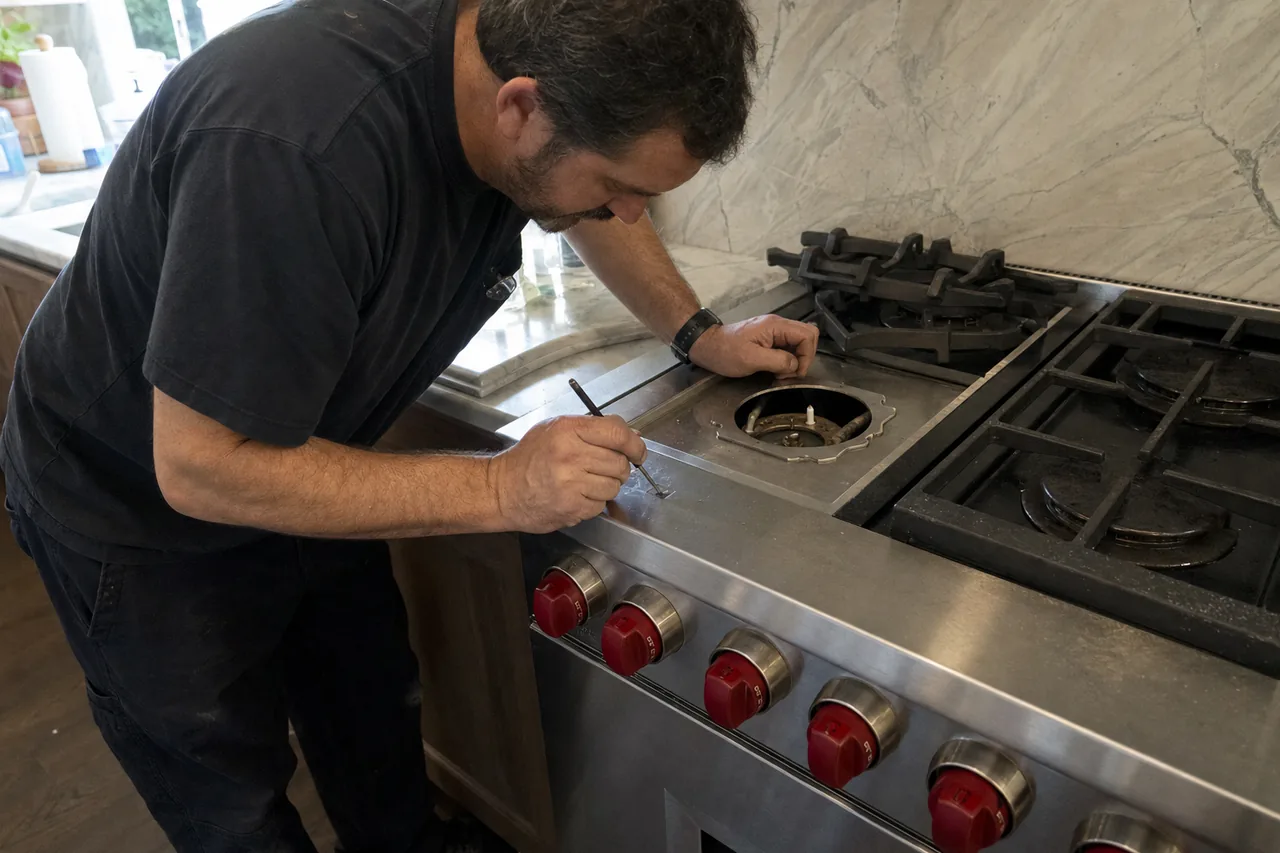
Wolf griddle cleaner is a concentrate you dilute, not a spray you squirt straight onto the steel. Stir 1 teaspoon (5 ml) of it into 1/2 cup (120 ml) of warm water, scrub that mix over the griddle plate once it has cooled from cooking heat to merely warm, and use a flat scraper to push the loosened residue into the grease tray. Wipe the plate with a damp cloth, dry it fully and give it a thin film of oil straight away, because the cleaner lifts the seasoning along with the grime.
That deep strip is an occasional job. On most days the griddle only needs a scrape and a light oiling while it is still warm, and the bottle stays in the cupboard until food begins to stick.
Using the cleaner, step by step
Set out the bottle, a cup, a scouring pad, a flat griddle scraper, rubber gloves and two clean cloths before you start.
- Turn the griddle off and let it fall from cooking heat to warm. On a very hot plate the solution steams away before it can loosen anything.
- Pull the grease tray, empty it and slide it back, so the scrapings have somewhere to land.
- Mix the cleaner into the warm water in the cup rather than pouring concentrate onto the plate.
- Pour a little of the mix onto one end and scrub in overlapping passes with the pad, adding more as the area dries.
- Scrape the dark slurry toward the tray opening and into the tray, working across the full width.
- Wipe the plate twice with a cloth dampened in plain water to clear what remains of the cleaner, then towel it dry.
- Re-season before anything else touches the surface.
Daily care keeps the strip rare
After each cook, while the plate is still warm, scrape bits of food into the tray and rub a few drops of oil across the surface with a folded paper towel held in tongs. That thin layer feeds the seasoning and shuts out moisture. Bring out the cleaner only when there is a reason: eggs grabbing where they used to slide, a tacky brown film that stays sticky after heating, or black flecks turning up on the food. Stripping every week wears the finish down faster than cooking can build it back.
Jacksonville’s damp summer air is hard on bare steel, so never strip the griddle and leave it unoiled overnight; orange rust freckles are the usual result.
Re-seasoning after a strip
Re-season the plate the same way Wolf has owners season a new dual fuel range infrared griddle before its first use. Heat it at 350°F (175°C) for 30 minutes. Let it cool slightly, then spread a thin coat of peanut or vegetable oil over the whole surface. Bring it back up to 350°F and leave it there until the oil just starts to smoke, with the hood running. Turn it off, let it cool and wipe away anything that pooled.
Thin is everything here. Oil left standing in puddles bakes into the same gummy film the cleaner was used to remove, so two light rounds beat one heavy one.
What the black stuff on a griddle is
Black flakes on food are nearly always one of two things: grease and food that carbonized on the plate, or an old, thick layer of seasoning that has begun to lift. Both respond to the same treatment, a full strip with the diluted cleaner and the scraper followed by a fresh, thin seasoning. Skip coarse wire brushes and anything else that gouges, since scratches give food more to cling to. If the flakes return within a few weeks, the usual culprit is too much oil at each wipe-down.
The right cleaner for the rest of the range
The griddle cleaner belongs on the griddle. Elsewhere on a Wolf range, gentler products do the work.
Burner grates clean at the sink in hot water with mild dish soap, or with a baking soda paste on stubborn spots, rather than being soaked. Control knobs get a damp cloth and nothing harsher. A burner igniter that looks crusty can be brushed gently with a soft toothbrush, but one that is cracked, broken or loose is a repair, not a cleaning job.
On a dual fuel range, press and hold Lock for 3 seconds before you wipe the control panel, and spray any degreaser onto the cloth rather than onto the panel itself. Powdered scouring cleansers come up often; keep them off the seasoned griddle, the porcelain oven interior and the glass, and leave the oven door gasket alone entirely, because rubbing it can spoil the seal. For brushed stainless, a non-abrasive stainless cleaner wiped along the grain is the safer habit. The oven side has its own routine in our oven maintenance and cleaning note.
When cleaning will not fix it
Some griddle complaints have nothing to do with dirt. On DF3050-DF6050 dual fuel ranges converted from natural gas to LP, the griddle is the only burner that gives up 2,000 Btu, so a slightly slower warm-up on propane is expected rather than a fault. Wolf wants that conversion done by a service technician, using kit 829533 for natural gas to LP or 829536 for the reverse.
A griddle that clicks and never catches, lights and then drops out, or heats in one patch only needs a look at the burner and its igniter. Igniter or spark module replacement typically falls between $200–$510, and the firm figure comes after the $80 diagnostic. The dual fuel range repair page covers those burner faults, and Kindling Range Service can be reached at +1 (904) 867-2707.
$80 flat diagnostic, credited toward the repair when you go ahead with it. +1 (904) 867-2707
What it costs
What does this kind of maintenance cost?
The visit itself is a flat $80. That buys the trip and the whole diagnostic sequence, and it comes off the total the moment you approve the work. What the work runs to on equipment of this class is below.
| What gets replaced | Parts and labour |
|---|---|
| Burner valve or orifice service | $210–$690 |
Questions
Asked about this note
- How do you clean a Wolf griddle?
- Scrape it while it is still warm after every cook and rub on a few drops of oil. When food starts to stick, do a deeper strip: 1 teaspoon of Wolf griddle cleaner stirred into 1/2 cup of warm water, scrubbed over the warm plate, scraped into the grease tray, wiped with plain water, dried and oiled again before the next use.
- Can I use a powdered scouring cleanser on a Wolf oven?
- Not on the inside. Grit can scratch the porcelain cavity and the glass, and on the griddle it strips oil the plate needs. Leave the oven door gasket alone completely. For brushed stainless trim, a non-abrasive stainless cleaner wiped along the grain is the safer habit; if you do try a mild powder there, test a hidden spot and rinse it all off.
- How do I get the black stuff off my griddle?
- Black flakes are usually carbonized grease or an old layer of seasoning that has begun to lift. Strip the plate with the diluted griddle cleaner and a flat scraper, push the residue into the grease tray, then season it again with thin coats of peanut or vegetable oil. Heavy oiling is the usual reason the flakes come back.
- What if my Wolf griddle will not light or heat?
- That is a burner fault, not a cleaning problem. If it clicks without catching, the igniter is the usual suspect; igniter or spark module replacement typically runs $200–$510, with the firm price set after the $80 diagnostic. On a dual fuel range converted to LP, a slightly gentler griddle is normal, since it is the one burner that loses 2,000 Btu.